
Averting a Foreclosure at the Courthouse Steps
How NHCG turned an imminent auction into a temporary forbearance, a short-term bridge, and a full note takeout — inside 30 days.
The matter in one screen
Real equity, trapped behind a hard deadline.
A multi-member ownership group owned roughly 7 acres of land in a major Southeast U.S. market. About three years earlier, the group had financed the asset with a private mortgage of roughly $5.0 million carrying an 18% interest rate. Payments were made on time for about two and a half years.
Then a cascade of unrelated problems — construction litigation, the death of a partner, and a broader liquidity squeeze — pulled the sponsor's attention away, and the loan went unpaid for roughly seven months. Unable to reach the borrower after repeated attempts, the private lender accelerated the debt, appointed a substitute trustee, and set the property for a non-judicial foreclosure sale on the courthouse steps. By the time NHCG was brought in, the auction was days away.
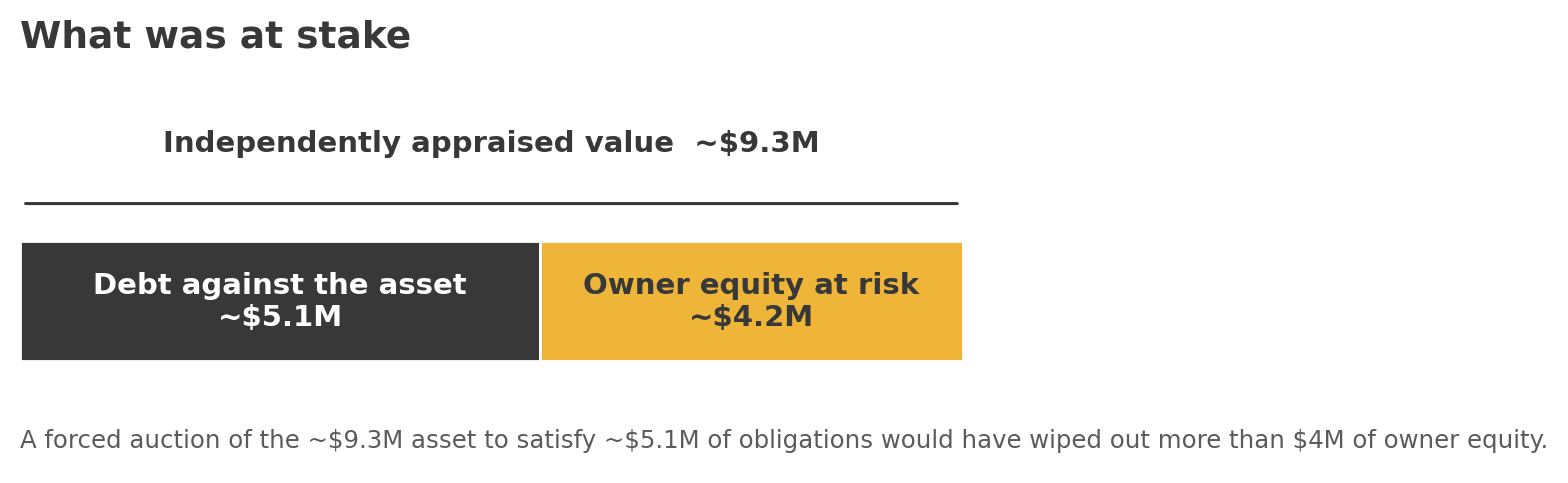
The stakes were severe and asymmetric. The asset had been independently appraised at roughly $9.3 million — nearly double the ≈ $5.1 million of obligations against it (the mortgage plus about $126,000 of back taxes and association arrears). A forced sale would have satisfied the debt and erased more than $4 million of the owners' equity in a single morning (Exhibit A).
On paper, refinance or sell. In practice, every exit was blocked.
Clouded title
An active lis pendens from the sponsor's separate construction dispute encumbered the property. Earlier good-faith attempts to sell or refinance had already failed for exactly this reason — no new lender could take clean first-lien collateral while the cloud remained.
A partner's estate
A minority member had recently passed away, and that interest was now held by an estate in probate — complicating signing authority and the pledge of collateral precisely when speed mattered most.
A distracted, over-committed sponsor
The principal was simultaneously carrying several active lawsuits, an appeal on a hard deadline, and other portfolio pressures — leaving little bandwidth to run a complex workout.
No runway for a conventional close
A bank refinance takes 45–90 days. The foreclosure sale was inside two weeks. The math simply did not work.
A distressed-debt engineering exercise, not a financing errand.
The objective was narrow and time-boxed: stop the sale first, then replace the hostile debt on the sponsor's terms.
Buy time at the courthouse steps
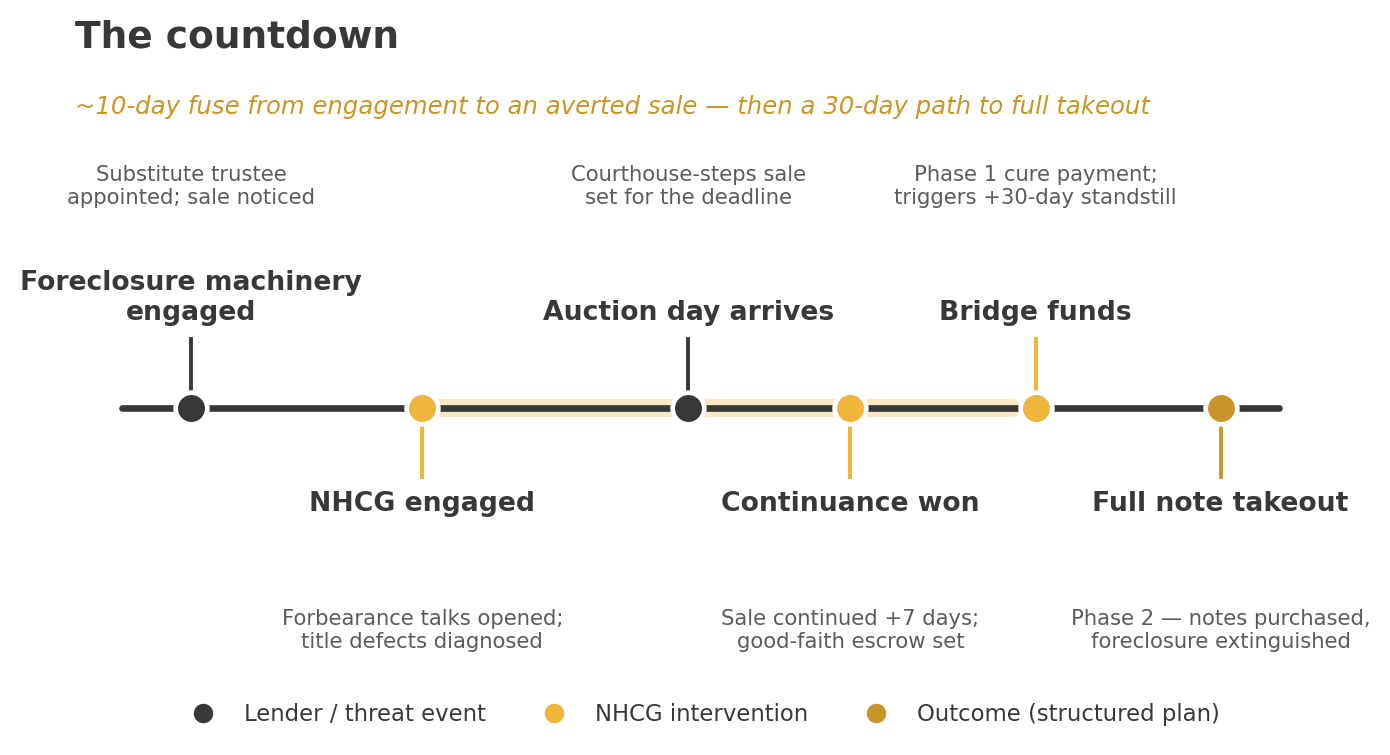
Rather than chase a refinance that could not close in time, NHCG worked the lender's side directly. Through the substitute trustee, the scheduled sale was orally continued and rescheduled a week out — the single most important move — paired with a good-faith escrow deposit that gave the lender a concrete reason to hold off.
Structure a temporary forbearance
With the sale paused, NHCG negotiated a short-term standstill: once the good-faith payment funded, the lender would extend the continuance a further 30 days — long enough to execute the permanent fix.
Source decisive rescue capital
NHCG brought in a private bridge-capital partner it knew could move without committee approval — a single decision-maker able to commit and fund on a compressed timeline. That decisiveness was the difference between a plan and a save.
Engineer a two-phase solution
Instead of one loan racing an impossible deadline, NHCG split the rescue into a small, fast bridge to stop the sale, followed by an outright purchase of the defaulted notes — turning an adversarial foreclosure into a friendly, lender-to-lender note sale the sponsor's new capital partner controlled.
Clear the path to closing
In parallel, NHCG drove the workstreams that would otherwise have derailed the timeline: an independent appraisal, a collateral package giving the new lender 2× coverage, estate and authority items tied to the deceased member's interest, and specialized closing counsel who could paper the loan on a days-long schedule.
The rescue structure
| Phase | What happens | Approx. size | Effect |
|---|---|---|---|
| Phase 1 Bridge | A private bridge loan funds a cure payment; secured by a first-position mortgage and assignment; ~1-year term, extendable. | ≈ $577.5K + costs & reserves | Stops the sale; triggers a 30-day standstill. |
| Phase 2 Takeout | The capital partner purchases both defaulted notes outright, stepping into first-lien position and extinguishing the foreclosure. | ≈ $5.0M + accrued interest | Replaces the hostile debt; preserves ownership and equity. |
Figures approximate and rounded; the structure reflects the engagement plan.
A sale days away, called off — and the threat removed entirely.
- The auction was averted. A sale that was days away was continued — first by a week, then, once the good-faith payment funded, by a further 30 days.
- A forbearance replaced a foreclosure. The posture shifted from "lender vs. borrower on the courthouse steps" to a negotiated, time-boxed workout.
- A short-term bridge stopped the bleeding. Phase 1 funded the cure and bought the runway.
- A full note takeout removed the threat entirely. Within roughly 30 days, the sponsor's capital partner purchased both notes — extinguishing the foreclosure and putting the sponsor back in control, with runway to complete a sale or joint venture on its own timeline.
Net effect: an asset independently valued near $9.3 million was kept out of a fire sale, and more than $4 million of owner equity that would have vanished at auction was preserved.
Expertise, attention to detail, execution.
Expertise
NHCG recognized immediately that the answer was not a refinance but a note purchase — and knew how to move a foreclosure from the courthouse steps to a negotiating table.
Attention to detail
Title defects, a probate estate, back taxes, and collateral coverage were each identified and worked in parallel, so none became the item that blew the deadline.
Execution
The firm sourced decisive capital, secured the continuance, and drove appraisal, documentation, and closing counsel on a days-long clock — the follow-through that turns a strategy into a save.
When the clock is short and the stakes are large.
NHCG advises hotel owners, developers, lenders, and their counsel on high-stakes, time-sensitive situations — distressed debt and note purchases, foreclosure and forbearance strategy, bridge and rescue capital, acquisitions and dispositions, and litigation support. When value is on the line, we bring the hospitality expertise, capital relationships, and execution discipline to protect it.
About this case study. This case study is drawn from an active NHCG engagement. The names of the parties, the property, and its location have been withheld and identifying details generalized to protect client confidentiality. Financial figures are approximate and rounded. The bridge financing and note takeout described here were structured and in execution at the time of writing; the two-phase structure and the 30-day takeout reflect the transaction as designed and are presented for illustration. Nothing in this document is legal, tax, or investment advice.